Pacific Beach Density Bonus Redevelopment and What It Means
August 27, 2026
August 27, 2026
"Pacific Beach benefits from additional residential units when they are developed thoughtfully and in the right locations," Marcella Bothwell, chair of the Pacific Beach Planning Group, told Times of San Diego this month about a modest 17-unit project slated for three vacant storefronts on Grand Avenue. Two miles north, a very different project has been fighting the city, the community, and now two new state laws over a plan to put 213 units, including 139 hotel-style rentals, into a tower nearly eight times taller than the neighborhood's height limit allows.
Both projects rely on the exact same statute. That is the part worth sitting with if you are looking at property anywhere near a commercial block in Pacific Beach right now.
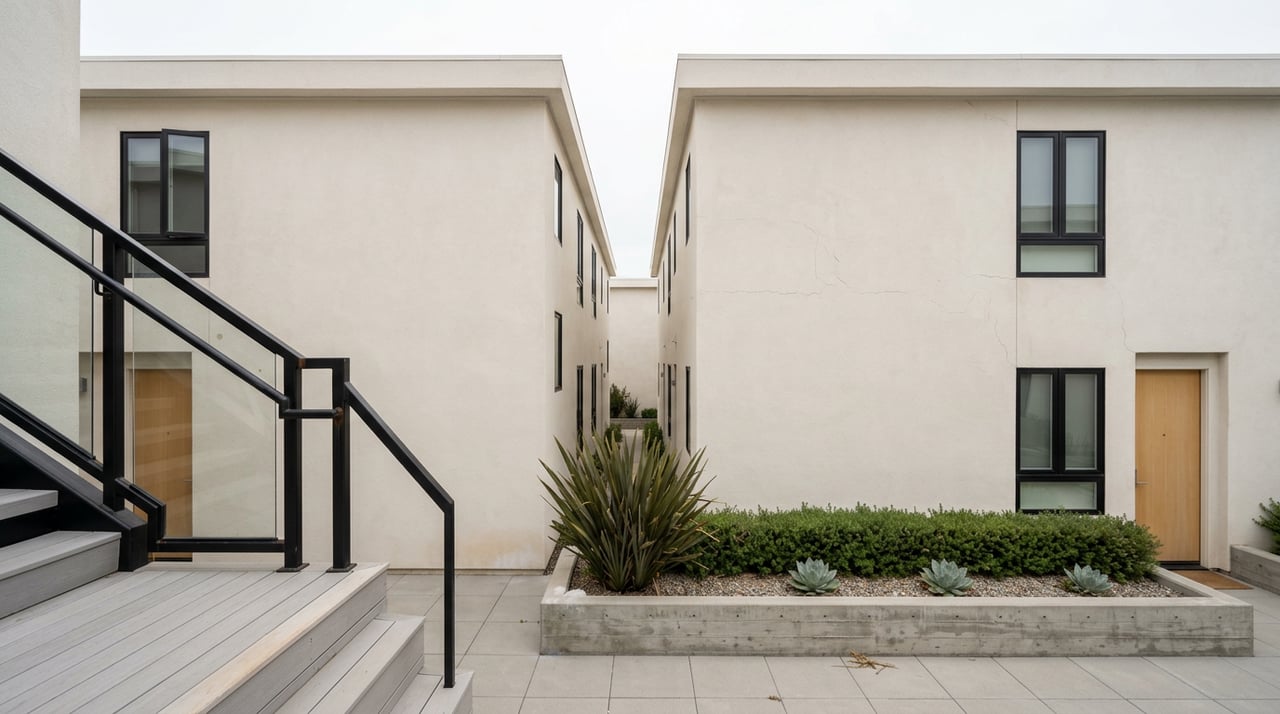
On August 7, 2026, Golba Architecture submitted plans to the city on behalf of a developer to demolish three small, mostly vacant commercial buildings and a residence-turned-business at 866 to 872 Grand Avenue. In their place: a three-story, 11,231-square-foot building with 17 units, two of them deed-restricted affordable, and a three-space carport tucked into the ground floor. Architect Tim Golba told Times of San Diego the existing structures "appear to have been intended for housing and will not return to that use."
The site sits next to the former IHOP building, which closed after more than two decades on the corridor and sold for $8 million earlier this year to an entity called 856 Grand Ave LLC. Carson Trujillo of WHITEWATER Commercial Real Estate, who represented the buyer, said the parcel's location a block from the beach made it a rare find. Golba was careful to note that nothing has been designed yet for that neighboring lot, only that a similar transformation is expected. A city hearing officer is expected to rule on the 17-unit application within the next few weeks.
This is the routine case. The lot was already zoned commercial, mixed-use is allowed there by right, and the density bonus law simply let the developer add a couple of extra units in exchange for setting two aside as affordable. Bothwell called the buildings "emblematic of struggling storefronts in the neighborhood" and said projects like this can strengthen rather than compete with the businesses around them.
Now compare that to 970 Turquoise Street, a 0.67-acre site in North Pacific Beach currently home to low-rise commercial buildings, including the longtime French Gourmet bakery. Developer Kalonymus Development Partners filed its first application in August 2024 for what became known as Project Vela, or the Turquoise Tower.
The base zoning on that parcel allows roughly 31 units. Kalonymus stacked bonuses on top of that base: a 50 percent density bonus for setting aside very-low-income units, another 50 percent bonus for moderate-income units, and an additional local bonus for including three-bedroom layouts. That math got the residential count to 75 units, split between market-rate apartments and income-restricted units. Then the developer added 139 more units it classified as "visitor accommodations," pushing the total to roughly 213 and the height to somewhere between 238 and 239 feet, 22 to 23 stories, on a site the city's coastal height limit caps at 30 feet.
The city's Development Services Department drew the line at that classification. In a December 23, 2025 letter that became public in February 2026, the department told Kalonymus the project "cannot be approved at this time" because it was attempting to count some of those 139 units as hotel rooms for bonus purposes while telling the community it intended to lease them long-term as apartments. As city officials put it, the developer could not have it both ways.
Kalonymus responded by arguing the project should be considered automatically approved because the city allegedly missed a state-mandated review deadline. Pacific Beach Town Council President Charlie Nieto called this an attempt to "strongarm the city into immediately approving its permits." City policy adviser Christopher Ackerman-Avila said the city has options to challenge that claim. In July, Congressman Scott Peters sent Mayor Todd Gloria a letter urging denial, writing that the tower "should not be built at the outrageous height currently proposed." As of the most recent public records reviewed by the community group Neighbors for a Better California, the project remains under active city review with no final decision issued, and key technical questions about floor area calculations, fire protection, and stormwater management are still unresolved.
Here is the side-by-side, because the numbers make the point better than any summary can:
| 866-872 Grand Avenue | 970 Turquoise Street | |
|---|---|---|
| Filed | August 7, 2026 | August 2024 |
| Existing site | Three vacant storefronts, one converted residence | Low-rise commercial buildings, including a longtime bakery |
| Base zoning capacity | Commercial, mixed-use allowed by right | Roughly 31 units |
| Density bonus result | 17 units, 3 stories | 75 residential units plus 139 visitor-accommodation units, roughly 213 total |
| Affordable units | 2 | 10 |
| Height | Within the 30-foot coastal limit | 238 to 239 feet |
| Status as of August 2026 | Awaiting a hearing officer decision | Under active city review, no final decision, litigation threatened |
California's density bonus law was designed to let developers exceed local zoning limits, including San Diego's voter-approved 30-foot coastal height cap, when a project sets aside a meaningful share of units as affordable housing. It has become the single most widely used state tool for speeding up housing approvals. On a corridor like Grand Avenue, where the base zoning already permits mixed use, that tool works close to how it was intended: a couple of bonus units in exchange for a couple of affordable ones, on a building that still fits the neighborhood's scale.
The Turquoise Tower stretched that same tool by leaning on commercial floor area, not residential floor area, to justify most of its height and scale. State Senator Catherine Blakespear, whose district covers this stretch of coast, authored SB 92 specifically to close that gap. The law, signed by Governor Newsom and effective January 1, 2026, requires density bonus projects to devote at least two-thirds of their floor space to residential use and caps any commercial floor area increase at 2.5 times what local zoning would otherwise allow. A companion bill, AB 87, was described by its author as a direct response to Project Vela and passed the Assembly 54-0. Neither law reaches back to cancel an already-filed application, which is why Vela is still being fought over rather than automatically resolved, but both close the door on any future project trying the same move.
If you have been reading about Pacific Beach as a neighborhood suddenly full of new apartment buildings, this is the mechanism underneath that headline, and it is not the same mechanism in every case.
The practical takeaway for a buyer is not that Pacific Beach is becoming one thing or another. It is that exposure to this kind of redevelopment pressure tracks with underlying zoning, not with how a block feels today. A few questions are worth asking before you make an offer near any PB commercial corridor:
None of this changes what a home is worth today. It does change how confidently you can predict what the block looks like in five years, and that confidence is worth having before you sign.
Does SB 92 stop the Turquoise Tower? No. The law applies to projects filed after January 1, 2026. Project Vela was filed in 2024 and remains under city review on its own timeline.
Does any of this affect a single-family home on an interior residential block? Generally, exposure to this specific dynamic is tied to nearby commercial or mixed-use zoning and, separately, to transit-overlay status under SB 79. A home well inside a residential block, away from both, is not working from the same base entitlement that made either Grand Avenue or Turquoise Street possible.
When will the Grand Avenue project be decided? A city hearing officer was expected to rule within weeks of the August 20, 2026 filing becoming public. The former IHOP site next door has no design submitted yet.
If you are weighing a property near one of Pacific Beach's commercial corridors, or trying to read what a filed project two blocks away actually means for your timeline, this is exactly the kind of question worth a direct conversation before you write an offer. San Diego Dream House can walk through the specific parcel, the zoning underneath it, and what the current filings mean for your plans. Request a Complimentary Consultation to get started.
Stay up to date on the latest real estate trends.
Debbie is passionate about making a difference through real estate, and she's committed to ensuring that every client receives the highest level of support and guidance.